
The correlation between legislative and executive powers in the RA Constitutional Amendments Draft
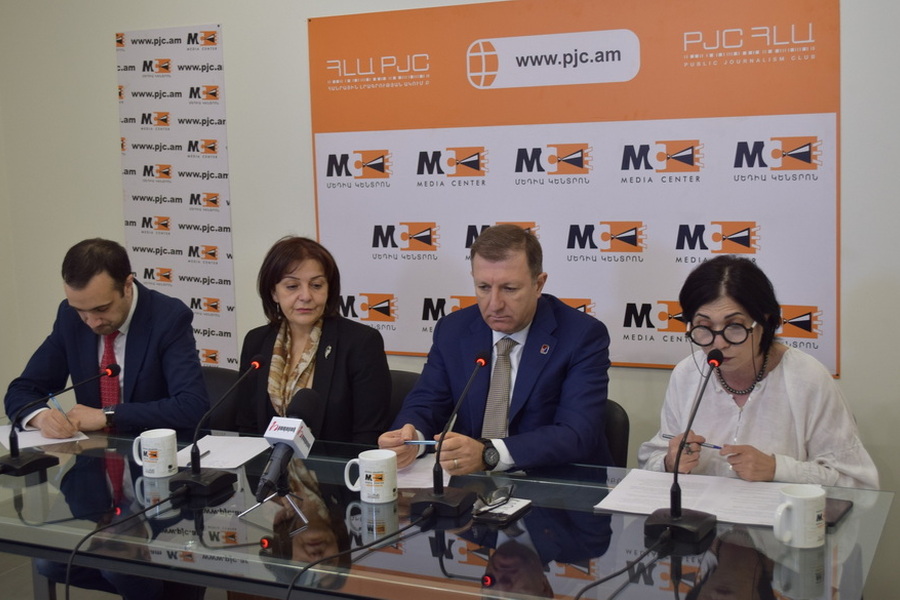
On November 10, 2015, Varuzhan Hoktnyan, Executive Director of Transparency International Anticorruption Center (TIAC) took part in public discussion “Constitutional Amendments in Armenia: the Separation of Powers and Balance in RA Constitutional Amendments Draft” and addressed “The correlation between legislative and executive powers in RA Constitutional Amendments Draft.” He made a presentation on how the correlation between legislative and executive branches of government is formally regulated in the draft constitution and if the draft enabled for effective application of checks and balances mechanism, comparing the proposed one with other countries’ experience.
Varuzhan Hoktnyan started his presentation citing Lord Acton’s quotation, “Power corrupts; absolute power corrupts absolutely,” which is TI global anticorruption movement’s slogan. As regards corruption prevention, in view of independence of legislative and executive branches of government and lack of checks and balances system there is a threat of absolute power. In modern world with strengthened executive power a question arises, how legislature can control the executive.
Some provisions strengthen National Assembly’s oversight role by creating investigative commissions and strengthening inquiry institute, however, at the same time there are serious provisions that strengthen lack of the government’s oversight by National Assembly.
The concept of the so called rational parliamentary system was adopted based on the idea of constructive vote of no confidence, i.e. in case of vote of no confidence in prime minister, alternative candidacy should be immediately nominated. Since the executive power is vested in the government, it receives strong position because of constructive vote of no confidence. Given the rigid structure of National Assembly factions, a question arises whether or not the MPs can leave their factions. If they are allowed to leave the factions can they create parliamentary groups? Whether or not independent MP concept shall work? If the Rules of Procedure of the National Assembly stipulates ban of changing factions no confidence vote would practically be impossible, which strengthens the government position. If the Police and National Security Service become ministries – part of executive power and armed forces is under the oversight of the government (the prime minister is the commander- in-chief in peaceful conditions) the executive branch will get great authority by the current draft.
As the semi-presidential system has turned into superpresidential one, there is a threat that parliamentary system may lead to superprimeministerial or supergovernmental system.
We face transition to quasi-one-party system when there is one political party and some parties for entourage that will play no role in political life. Armenia is among the countries having consolidating authoritarian regime. Political party system is weak. In the current situation if the opposition has fewer votes than 3/5 all appointments and constitutional laws will be adopted by one ruling political party or majority. If the ideology of the ruling political party becomes the state ideology as well, we would have great risk to pass to partocratic system which is even worse than one-party system.